This is an updated version of the original post about the Neutra Kaufmann House that I wrote some time ago.
I decided to replace the previous pics with the amazing photographs I found in the Julius Shulman -the photographer of modernism- archive.
Be sure to read the post until the end to find out how to get all the 30 photographs I found!
Ten years later commissioning to Frank Lloyd Wright the iconic Water Falling House, Edgar Kaufmann was looking for an architect to design his new house near Palm Springs: later known as the Kaufmann Desert House.
Kaufmann, decided for the light style of Richard Neutra; more suitable for the frivolous Palm Springs than Wright’s style.
The wild desert area surrounding Palm Springs intrigued Neutra. He wanted to bring back the spirit of the flat-roofed with mudbrick boulders houses from the early inhabitants of the nearby ‘desert states’ New Mexico and Arizona. In a way Neutra brought a polished version of those houses that responded to the punishing climate.
Being aware of inevitable comparisons with the Falling Water House, Richard Neutra highlighted the difference between his and Wright’s approach to architecture stating that his designs were “inserted” in the landscape and “not grown” there. Designing the Kaufmann House, Neutra juxtaposed the building and the surroundings to underscore “the weather, the silver-white moonlight, and the starry sky.”
The Richard Neutra Style.
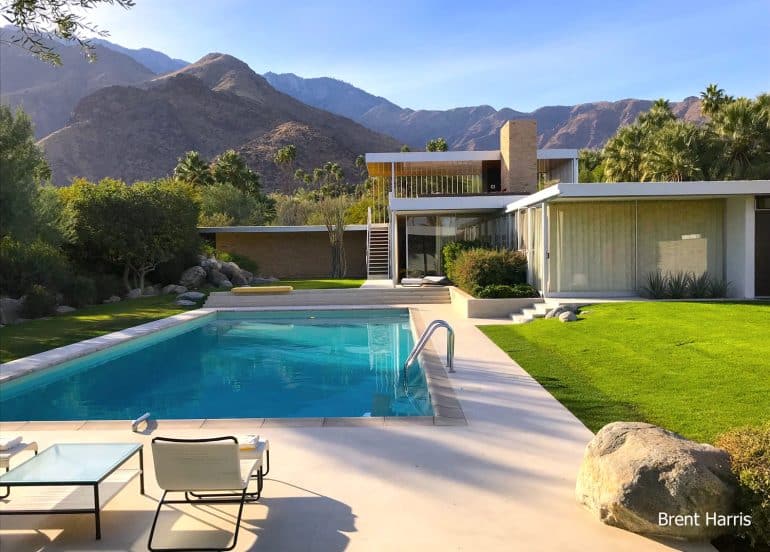
Differently from the Lovell House, the Kaufmann House volumes expanded into the site. The space was divided by shiny horizontal planes sliding above transparent glass.
The only vertical element was the rooftop space -that Neutra Called “Gloriette”- flanked by a chimney. In this space -dominating the rest of the house- the architect get rid of the walls using vertical aluminium louvers that acted as wind shield. The only fixed element included was the fireplace.
The house had the living area as hub and the pinwheel plan helped the four arms of one-volume rooms to get enough daylight and ventilation. At the end of each arm were placed the bedrooms: for the hosts, servants, children and guests; see the blue print at the end of the post.
The dwellers could gathered along the shaded walkways and in to public indoor or outdoor spaces.
Not only Neutra provided the Kaufmanns and their guests with comfort and privacy inside the house but also with a comfortable outside space.
As an example, the louvers flanking the lily pond created a cooled patio protected by sand storms. The radiant heat -placed in the low seating wall- accompanied the hosts an their guests from the house to the pool warming them during a pool party on a chilly January night; the only month the Kaufmann lived the house.
What later became the Neutra’s trademark, is the floating effect obtained combining wood and steel in a way that reduced the necessary vertical supports.
This is evident on the living room whose glass and steel walls open while the roof and the beam supporting the sliders disappear; spatially and visually linking the house with the pool.
Neutra’s will to pay homage to the desertic area surrounding the house it’s clear looking at the materials he used. The so called “Utah buff” stones decorating the indoors and outdoors complemented the smoothness of the other finishes and were perfectly chiseled by the masons whom also worked at the Wright Falling Water House.
Details make the difference and Neutra knew it. In the Kaufmann House the gutters -at their eastern end- suddenly became much narrower just before their end. In this way they allow any overflow rainwater to flow east beyond the building before it falls below; a feature of typical Japanese gardens and medieval cathedrals but also an homage to the Falling Water House.
Most of the pics in this post are from the stunning Julius Shulman, Modernism Rediscovered a -cheap- must have if you love mid century modern architecture and photography. Check it now!
Joining the Mid Century Home mailing list you will also receive not published and original content about mid century modern design and architecture: no spam guaranteed!
Enjoyed this post?
Learn more about Mid Century Modern with the free Newsletter!

I am with you. This house is incredible.
Have you ever visited it?
Great article with some views of the KAUFMAN house that I havent seen before.Nuetra was brillaint and way ahead of his time ..moden residential architects are only just statting to appreciate him
Thanks Greg! I do believe as well that he had an huge influence on contemporary architecture.
Which is your favorite view? Mine is the one in the fifth pic. It seams like the ceiling is floating…
Thanks for stopping by.